Currently a company called Desktop Metal's Studio is building a printer that can 3D print metal. This can make prototyping creations faster and cheaper (essentially more efficient). This new printer can help engineers prototype their ideas and help large companies mass produce their products. In addition, it can use a variety of alloys to make many different structures of different strength. Desktop Metal also offers software that can help make designing a product easier and basic models that can make printing easier.
https://newatlas.com/desktop-metal-3d-printing/50654/
Saturday, March 31, 2018

Earbuds that Allow You to Understand Any Language
Have you ever wondered what it would be like to be able to communicate with anyone in the world? To be able to effortlessly understand anyone, because there was no language barrier? Well, GOOGLE has created earphones that can translate 40 different languages and allow you to understand what other people are saying. Currently, laboratory tests show that the languages can be translated fast enough by the earbuds to help people hold a conversation. However, there are many external factors in our regular environment can can potentially hinder the earphones abilities to translate languages quickly. Nevertheless, these earphones have the potential to help break down language barriers across the world.
https://qz.com/1094638/google-goog-built-earbuds-that-translate-40-languages-in-real-time-like-the-hitchhikers-guides-babel-fish/
https://qz.com/1094638/google-goog-built-earbuds-that-translate-40-languages-in-real-time-like-the-hitchhikers-guides-babel-fish/
Monday, March 26, 2018
Walk it , talk it
Every individual that was put on this earth, was placed here for a reason. Each and every person has something special about them that sets them apart from others. What we don't see, is the problems that every individual has to face on their own and how much of an effect it could have on daily life. In the modern world, several people have to deal with Multiple Sclerosis which makes difficulty when walking. Without being able to walk, it puts a lot of pressure on the lives of these people since they aren't allowed to be the free individual that they once were. They now need assistance from a person or technology in order for them to get from point A to point B. Doctors and scientists have to come to see that this is a real problem in our society and a change is needed. They have been through many hours of devotion to enable them to fix this ailment. They have found that they are able to inject new stem cells into the bone marrow of patients dealing with this disease. Once this taken into place, the immune system is completely replaced. This is a one time procedure that has proven to change the outcome of individuals living with this condition.
http://myregenmed.com/5-advancements-in-stem-cell-therapy-that-will-excite-you/
http://myregenmed.com/5-advancements-in-stem-cell-therapy-that-will-excite-you/
Fingerprint Recognition Guns!
IDENTILOCK, the Fingerprint Recognition system, claims that their mission is not only to bring new technology to the gun lock world, but it is to prevent gun-related accidents and lift the negative stigma that surrounds firearms. However, the problem with this is that this type of technology is largely untested and not failsafe. Batteries do go dead. Technology glitches do happen. Firearms malfunction as well, but generally speaking, if you keep your tool of self-defense in decent condition and fire and clean it regularly, these types of occurrences are fairly rare. In addition, this technology is very elitist. Guns are not cheap to purchase, and adding this technology only makes it that much more expensive. Although this technology has some negative consequences, however, it could prevent unauthorized discharge of a firearm by children, people attempting to commit suicide, and people untrained to use the weapon.
Sunday, March 25, 2018
Tiniest Computer Chip in the World?
/cdn.vox-cdn.com/uploads/chorus_image/image/59084809/ibm_smallest_computer.0.jpg)
The chip on the person's finger in the picture shown above seems pretty small right? And squishing everything that makes up a computer on that tiny chip seems pretty impressive right? Well, that is actually made up of "64 motherboards, each of which holds two of this tiny computer". I don't know about you, but I was mind-blown by that. Below is a picture of the actual computer on a pile of salt.
/cdn.vox-cdn.com/uploads/chorus_asset/file/10456451/ibm_computer_salt.jpg)
Can you even see the computer?
Although this isn't a reality yet, IBM is saying that they would create this 1mm x 1mm computer within the next five year. Apparently, they cost less than 10 cents to make as well! The obvious advantage of a tiny chip is that electronics would be build smaller while performing the same (or even better).
Friday, March 23, 2018
Robot Fish
SoFi is a robot fish designed to swim in open water and spy on the fishes living there. It has one eye, and a camera that can record the behaviors of the relationship between the predators and the prey. Scientists at MIT's Computer Science and Artificial Intelligence Laboratory created it, and they created SoFi with the motive of not impacting the natural habitat of the fish, and not rising any suspicions among the fish in that specific area.
There have already been test runs for SoFi, including one in Fiji's Rainbow Reef, where SoFi swam for 40 minutes in 50 feet of water. A diver was able to control the robot from 32 feet away using a Super Nintendo controller. The movement of SoFi is said to be graceful, smooth, and independent.
The introduction of this fish-like robot can help biologists to collect data and observations about ocean life. The creation of the robot fish can also lead to the creation of other animals, which can lead to further analysis of wildlife.
Link: http://money.cnn.com/2018/03/21/technology/mit-fish-robot/index.html
There have already been test runs for SoFi, including one in Fiji's Rainbow Reef, where SoFi swam for 40 minutes in 50 feet of water. A diver was able to control the robot from 32 feet away using a Super Nintendo controller. The movement of SoFi is said to be graceful, smooth, and independent.
The introduction of this fish-like robot can help biologists to collect data and observations about ocean life. The creation of the robot fish can also lead to the creation of other animals, which can lead to further analysis of wildlife.
Link: http://money.cnn.com/2018/03/21/technology/mit-fish-robot/index.html
Friday, March 16, 2018
What AI Can Do to Music

If you've ever made music using synthesizers before, you'll probably be confused as how artificial intelligence can change your creation experience. Google's new NSynth Super is an AI-backed touchscreen synthesizer. The NSynth generates sounds of real instruments, learns the core qualities of each individual sound, and then is able to combine sounds to create something completely new. The NSynth is split into 4 sections, each assigned a particular instrument. You can mix sounds by gliding your finger across multiple cells; however, the unique part of the NSynth is that it doesn't just layer sounds on top of one another; it synthesizes an entirely new sound based on the qualities of each sound. However, a drawback to the NSynth is that it is expensive and isn't 100% user friendly.
https://www.theverge.com/circuitbreaker/2018/3/13/17114760/google-nsynth-super-ai-touchscreen-synth
Thursday, March 15, 2018
Humans Fired a Burger Flipping Robot
Flippy, a robot built by Miso Flippy, is called "the world's first autonomous robotic kitchen assistant." It was used for a helper for fast-food restaurants. Flippy was made to operate with humans and to increase the speed in which fast-food restaurants could provide food. Flippy is especially talented in cooking and grill maintenance, and it has a spatula-tipped arm.
Although Flippy was made to assist humans, he ended up grilling patties faster than humans could assemble burgers. He was fired after two days. Flippy has an arm that can hold a spatula or grill scraper, and he also has a cloud-based AI and thermal vision that help it to determine how cooked the burger is. His skills proved to be too much for humans to handle, and he acted more as a human worker than an assistant.
Link: https://www.livescience.com/61994-flippy-burger-flipping-robot-flops.html
Although Flippy was made to assist humans, he ended up grilling patties faster than humans could assemble burgers. He was fired after two days. Flippy has an arm that can hold a spatula or grill scraper, and he also has a cloud-based AI and thermal vision that help it to determine how cooked the burger is. His skills proved to be too much for humans to handle, and he acted more as a human worker than an assistant.
Link: https://www.livescience.com/61994-flippy-burger-flipping-robot-flops.html
Can your phone help you detect abnormalities in your body?
Scientists at Washington University in St. Louis have discovered a way in incorporate ultrasound technology in smartphones in order to help people detect abnormalities in their bodies. These Ultrasound Probes are in USB form and able to be connected to your smartphone, so that when your body is being screened, the images will appear on your phone. It can help image organs such as kidneys and livers, in addition to veins, in order to help people see the activities inside their bodies. This medical imaging is effective and convenient, and has the potential to help people in areas of the world where technology, especially medical technology, is not easily accessible. It could also help people with diseases control and adjust the amount of medicine they have to take by themselves through the changes in activity in their body.
https://source.wustl.edu/2009/04/ultrasound-imaging-now-possible-with-a-smartphone/
https://source.wustl.edu/2009/04/ultrasound-imaging-now-possible-with-a-smartphone/
Sunday, March 11, 2018
The Future of Entertainment
James Ryan is working on a project that plays a podcast that is different for everyone. The podcast is called "Sheldon's County", and to listen to it, the person must first input a random number. This would start-up a process that creates random characters, relationships, and everything else that would make a juicy story. This would then be turned into text, which would be read by a voice synthesizer. Surprisingly, for his project, Ryan turns to old-fashioned AI techniques that guide the process through a set of rules and instructions instead of modern AI techniques. He says that modern AI techniques are not as helpful because they are more about mining data to look for patterns (deep learning). Although Sheldon's County is still very young in progress, it shows us a glimpse of what the future of entertainment might look like.
https://www.theverge.com/2018/3/11/17099578/ai-generated-podcast-procedural-storytelling-art-sheldon-county
Thursday, March 8, 2018
Artificial Embryos to create human life
Scientists from the University of Michigan have discovered that the growth of stem cells resemble structures of initial forms of human embryos. The only difference, is that the stem cells are unable to form organs such as the brain in order to provide human functions. In addition, embryos grown in labs die after a little more than a week. Still, to scientists, this proves that stem cells are able to remember the bodily functions that cells are suppose to do and grow to, which gives scientists hope that they will one day be able to grow humans in laboratories. However, there are ethical concerns regarding experiments such as these, and "embryos" cannot be studied for more than two weeks. Despite this, these scientists hope that their discoveries will one day allow them to grow human organs that can be given to people in need. The result will be that organ donations will no longer be necessary, because people who need new organs will be able to easily access he ones grown in laboratories.
https://www.technologyreview.com/s/608173/artificial-human-embryos-are-coming-and-no-one-knows-how-to-handle-them/
https://www.technologyreview.com/s/608173/artificial-human-embryos-are-coming-and-no-one-knows-how-to-handle-them/
A Wristband That Tells You If You're Too Drunk to Drive
A wristband that can monitor your blood alcohol content was created, and it has begun shipping at full production capacity in late 2017. Drunk driving is a huge problem in the modern world, and there are breathalyzers that people can use to measure their blood alcohol content, they are inefficient and awkward to use. Proof is a wristband that can analyze your blood alcohol content through your skin. This can help prevent the amount of drunk driving accidents.
Gadgets like these can help society today refrain from creating accidents, but as technology grows, the self driving car industry will also grow and come to replace many things. Although this gadget is useful now, in the future, when self-driving cars are the main form of transportation, this gadget will not be useful anymore because people will no longer need to know how to drive.
Link: https://www.ranker.com/list/cool-new-tech-2018/eric-vega?var=8&utm_expid=16418821-388.pwrOe5-lSJetLqzNW0S00A.3&utm_referrer=https%3A%2F%2Fwww.google.com%2F
Gadgets like these can help society today refrain from creating accidents, but as technology grows, the self driving car industry will also grow and come to replace many things. Although this gadget is useful now, in the future, when self-driving cars are the main form of transportation, this gadget will not be useful anymore because people will no longer need to know how to drive.
Link: https://www.ranker.com/list/cool-new-tech-2018/eric-vega?var=8&utm_expid=16418821-388.pwrOe5-lSJetLqzNW0S00A.3&utm_referrer=https%3A%2F%2Fwww.google.com%2F
Frozen in Time
As life goes on, new advancements are being made in every field of the world and we have no idea about it. For all we know, there could be a rocket taking off to go to space right now. Humans keep making incredible inventions, and along with these new inventions, comes higher level products. We seem to have all the tools we could need in this world we just need to find out where and how to use them. The human species have done incredible things which is why preserving our lives for the longest time possible has been the goal for scientists for many years. Recently, they have found that when freezing/cooling something it seems to stay in tact for longer and store everything the way it was left. This ideology was applied to humans and the after life. Researches have found that by freezing the human and injecting special stem cells, we can actually "freeze them in time" and revive them on a later date. Mr. Kowalski who is a big founder of this invention says that if he can do something this amazing, maybe one day some scientist will unfreeze these humans and use reverse engineering to revive them. There are still many tests to be done and research to be conducted before this actually starts to take effect and potentially change the way humans live.
Monday, March 5, 2018
New Blood
While doing research, I came across the topic of stem cells in the human anatomy and how big of a role it actually plays. There are many complications that come with blood transfusions and just dealing with blood in general. Recent studies have shown how with these stem cells, we are able to have more efficient transfusions and less issues. Scientists have been studying this for many years and are finally able to include their discovery in everyday life and help. They plan to do this by increasing the number of stem cells. By doing this, we have a limitless supply of clean blood that is ready for use.
Friday, March 2, 2018
Humans Teaching Robots to Fight Back
In this article by Live Science, Tia Ghose reveals that a robot dog that can fight off a human has been created. There was a video of a robot dog refusing to let the human get in his way of opening the door. It is said that when the dog is trying to open the door and a human comes to try to move the dog away from the door knob, the robot dog continues to open the door and stands there while the human tries to move him away.
Normally, robots are made to help humans and perform tasks that humans wouldn't want to do themselves, and this robot dog has these features. However, this robot dog created by Boston Dynamics isn't designed to help people in a disaster situation. He is more like an assistant, and he has more capabilities than a disaster robot. This robot is designed to be able to maneuver through challenges like doorways. slippery floors, and other obstacles. Giving robots the ability to fight back to their creators makes them more and more like humans. Maybe in the future, robot pets similar to live animals will be created and replace them.
Link: https://www.livescience.com/61840-robot-dog-fights-off-human.html
Normally, robots are made to help humans and perform tasks that humans wouldn't want to do themselves, and this robot dog has these features. However, this robot dog created by Boston Dynamics isn't designed to help people in a disaster situation. He is more like an assistant, and he has more capabilities than a disaster robot. This robot is designed to be able to maneuver through challenges like doorways. slippery floors, and other obstacles. Giving robots the ability to fight back to their creators makes them more and more like humans. Maybe in the future, robot pets similar to live animals will be created and replace them.
Link: https://www.livescience.com/61840-robot-dog-fights-off-human.html
An Upgrade to Security Cameras

Although the AI smart security camera is a good way to secure your home, its necessity is debatable.
https://www.theverge.com/2018/3/2/17009158/lighthouse-ai-security-camera-review-nest-google-amazon-smart-home
https://www.theverge.com/2018/3/2/17009158/lighthouse-ai-security-camera-review-nest-google-amazon-smart-home
ROBORACE
ROBORACE is going to be the world first robotic racing series. They are using something they call devbot which is a version of their car with a drivers seat so that they can program on move. Their devbot can go 137 mile per hour but their race cars will be able to go 207 miles an hour.
roborace
roborace youtube
roborace
roborace youtube
The Fingerprint Sensor on Your phone is Not Safe!
A touch of a finger can unlock a phone with no password. However, this convenience has left a gaping security hole. New findings published monday by researchers at NYU and Michigan State University suggests that smartphones can easily be fooled by fake fingerprnts digitally composed of many common features found in human print. In computer simulations, the researchers from the universities were able to develop a set of artificial "Masterprints" that could match real prints similar to those used by phones as much as 65% of the time. The researchers did not test their approach with real phones, and other security experts said the match rate would significantly lower in real life conditions. Still, the findings raised troubling questions about the effectiveness of fingerprint security on smartphones. Full human fingerprints are difficult to falsify, but the fingerscarrs on phones are so small they only read partial fingerprints. Phonemakers can increase security by adding a larger fingerprint scanner and adding some newer biometric security options, such as an iris scanner. Also, phone user can protect themselves by turning off fingerprint authentification for their most sensitive apps, such as mobile payments.
Thursday, March 1, 2018
Detecting Heart Disease Through the Eye
Recently scientists have been able to combine artificial intelligence and machine learning in order to help detect and predict patterns of heart disease in a person. This procedure is non-invasive, because it involves the use of cameras to observe the blood vessels behind the eyes of a patient, and then, judging from previously observation patterns from other people (Databases), the program is able to predict the trajectory of a patients heart health throughout their lives. This method is more efficient than other methods of testing for heart disease, because the results come back faster and it is non-invasive (less harmful to the body). By looking at the changes in pressure and flow of the blood vessels behind a patients eyes, the machine is able to help provide the health of your heart, so preventative measures can be taken early on. This is ultimately also help lower the expense of healthcare, because preventative measures are less expensive than that of measures taken when heart disease is in its later stages.
https://www.everydayhealth.com/heart-health/google-develops-artificial-intelligence-assess-heart-health/
https://www.everydayhealth.com/heart-health/google-develops-artificial-intelligence-assess-heart-health/
New York Faces A Big Cyber Threat
New York is the home of the most valuable stock exchange in the entire world. In the past 2 years there has been an increase in Cyber Attacks due to the wanting of money and people's personal information by black hat hackers. Right now, the NYDFS is very worried about their bank's online security since the number of online banking hacks has increased over the course of the past 2 years. The whole point of a bank is that the people trust the banks to hold their money, and if their money and information get stolen, the bank will lose the people's trust. That is the biggest fear of the NYDFS, is to lose all consumers due to Cyber Attacks, therefore, they are making big changes to their CyberSecurity regulations.
Link: http://www.businessinsider.com/new-york-cybersecurity-regulations-protect-wall-street-2018-2
Link: http://www.businessinsider.com/new-york-cybersecurity-regulations-protect-wall-street-2018-2
Monday, February 26, 2018
3D Metal Printing
Up until now, 3D printing that involves materials that's not plastic has been really tedious and time consuming. However, it's becoming more efficient and accessible. The advancement in 3D metal printing can change the way our society produces manufacturing parts. It wouldn't be necessary to have a large storage for big parts because they would be able to print an object when they need it. This can help for replacing parts on an old car. The advancement in this technology can change the conventional metal fabrication methods. It can result in a more in depth knowledge of the structure of metals.
Some examples of this advancement today is the creation of a 3D printing method by Lawrence Livermore National Laboratory that can create stainless-steel parts two times as strong as the traditional parts in 2017. There was also a 3D printing company called Markforged that released the first 3D metal printer for just under $100,000 in 2017. Desktop Metal, a company in Boston, began to sell the metal prototyping machines in December 2017, and they are looking to sell machines that are 100 times faster than the slow metal printing methods of the past.
Link: https://www.technologyreview.com/lists/technologies/2018/
A monkey with three loving parents
In the past years, there have been many experiments that have been conducted to create a species with more than two parents to create the offspring. Time and time again this has failed with animals such as mice, and previously monkeys. After seeing that the insertion of the stem cels seemed to be ineffective and perhaps may have died in the animal, the scientists at Oregon National Primate Research Center decided to take a different approach. Since this insertion did nothing, they decided to try even younger embryos which makes it even more flexible and allows it to develop into any type of cell. By having this insertion, they deemed to be successful and the result: three male rhesus macaques—twins Roku and Hex, and the singleton, Chimero. By having this experiment succeed and have three parents for the offspring, it gives hop for scientist to now get this done with humans and other species. Nobody knows how this will turn out to be if it does work with a human. They will have traits from not only two, but now three parents and potentially could work out in their favor.
http://discovermagazine.com/2013/april/1-more-than-two-parents
http://discovermagazine.com/2013/april/1-more-than-two-parents
Friday, February 16, 2018
Placenta Stem Cell Extraction
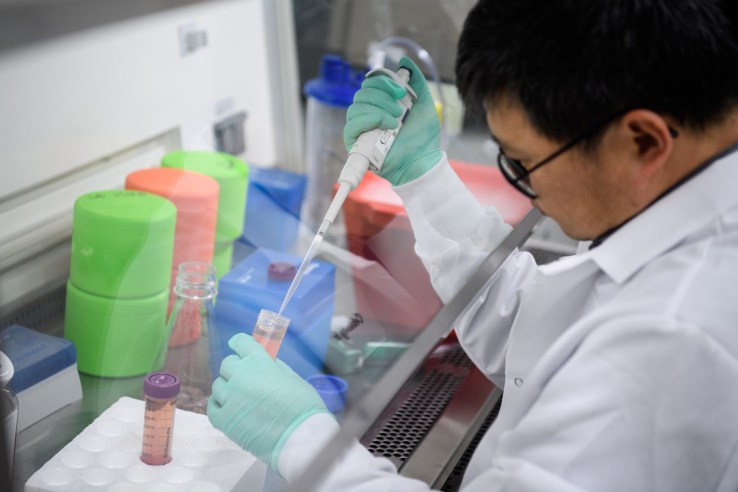
Stem cells derived from a human placenta hold the key to unlocking a myriad of potentials in regenerative medicine and are the focus of X-Prize and Singularity University founder Peter Diamandis’ new endeavor.
Called Celularity, the startup is a spinout from Celgene, a global biopharmaceutical company creating gene therapies. Diamandis teamed up with Dr. Robert Hariri, the founder of Celgene Cellular Therapeutics, to create Celularity in the hopes of using stem cells found in the human placenta to quickly regenerate tissue and organs needed to treat cancer and other diseases. The idea is these types of cells can do a better job of helping us live longer, fuller, healthier lives.
It’s a wild proposal and, seemingly, the stuff of science fiction often tossed around in certain Silicon Valley circles — create a startup focused on a medical breakthrough to make us live forever — or at least much, much longer than we currently do. But stem cell technology has been around for some time.
https://techcrunch.com/2018/02/15/peter-diamandis-new-startup-is-all-about-taking-stem-cells-from-placentas-so-we-can-live-forever/
Thursday, February 15, 2018
Robots in the Future of the Mining Industry.
The floor of the ocean is rich with ore, much more than the surface is. This makes underwater mining very valuable. The issue with this is that at deeper points, it is difficult for human operators to mine effectively using the usual machinery. That is why a lot of research and development has gone into robotic vehicles to make this kind of mining possible. The Canadian company, Nautilus Minerals, has created three different robots for this. They are operated from a ship using feedback from the numerous cameras and sensors aboard the mining vehicles. They each serve different purposes too. One clears away the mining site since the bottom of the ocean is often rough. Another digs up the ground and loosens the ore from the rock. The last then sucks up a combination of ore, rock, and sea water, which will be sorted later. This new technology could prove to open up massive new potential for mining companies. Not only this, but technology like this can be applied to other industries besides mining, such as oil companies.
AI and Earthquakes
You'd think that the abilities of seismologists to detect earthquakes are already quite advanced; however, they are still unable to detect smaller earthquakes, much less predict them. The idea of using artificial intelligence to amplify the sensitivity of seismographs was proposed by Thibaut Perol and his colleagues when they were investigating the cause of a spike in the number of earthquakes in Oklahoma. Their idea proved to be effective since it is capable of detecting 17 times more earthquakes than older methods in only a fraction of the time. This technique is similar to the voice detection software used by digital assistants, like Alexa or Siri, that ignores background noise to listen to voice commands. The seismograph cancels out the natural rumbling of Earth to spot small or far away earthquakes. Perol says that "with this method, we are able to detect earthquakes of magnitude zero or minus one, and these are signals you wouldn't be able to see with a human eye." This is a huge step for seismologists because it increases the possibility of using AI to predict earthquakes by looking for patterns in data.
https://www.theverge.com/2018/2/14/17011396/ai-earthquake-detection-oklahoma-neural-network
https://www.theverge.com/2018/2/14/17011396/ai-earthquake-detection-oklahoma-neural-network
Something is missing...
Something Missing
It may seem foreign, but today I learned that there are people in the world with such diseases whom do not have fingerprints. There are two diseases that result in the persons lacking of fingerprints. Researchers at the Technion-Israel Institute of Technology and Thomas Jefferson University report that defects in the protein keratin 14 may be responsible for both diseases, known as Naegeli syndrome and dermatopathia pigmentosa reticularis (DPR). Other symptoms include thickening of palms and soles of feet. Patients suffer from anomalies in the development of their teeth, hair, and skin, where pigmentation can appear patchy and uneven. This often causes abnormalities in the ability to sweat, which can lead to heat strokes as well as general overheating which is considered to be very dangerous to the carrier of these diseases.In terms of our project and the field as a whole, this leaves scientists and analysts with no way to identify such persons other than DNA testing. In the police and investigation field, this could prohibit or at the very least, slow the process. There are other ways to identify criminals, however, because there are some criminals who burn their fingerprints in order to prevent authorities from identifying them.
Source: https://news.nationalgeographic.com/news/2006/09/060922-fingerprints_2.html
Are Fingerprint Patterns Inherited?
Yes, there is an inheritable quality to fingerprints. Pattern types are often genetically inherited, but the individual details that make a fingerprint unique are not. Humans, as well as apes and monkeys, have friction-ridge skin (FRS) covering the surfaces of their hands and feet. FRS comprises a series of ridges and furrows that provide friction to help in grasping and preventing slippage. FRS is unique and permanent. No 2 individuals (including identical twins) will have the exact same FRS arrangement. Also, the arrangement of the features do not change throughout our lifetimes. The term fingerprints refer to the FRS on the ends of our fingers.
Fingerprints translates into 3 major pattern types-- whirl, loop, or arch. It is possible to have just 1, 2, or all 3 of the patterns among your fingers. However, an individual cannot be identified from fingerprints by pattern type alone. An examiner must look for a specific path of ridges and the breaks or forms in the ridges (minutiae.)
Fingerprints translates into 3 major pattern types-- whirl, loop, or arch. It is possible to have just 1, 2, or all 3 of the patterns among your fingers. However, an individual cannot be identified from fingerprints by pattern type alone. An examiner must look for a specific path of ridges and the breaks or forms in the ridges (minutiae.)
Asteroid mining
Deep space industry is using The Comet-1™ electrothermal thruster uses the most abundant resource in the solar system—water—as propellant. It is intrinsically inert, launch safe, and cost-effective. This low-power, low-profile, high total impulse micropropulsion system is CubeSat-compatible but incorporates a highly-flexible interface suitable for a wide range of spacecraft sizes. they are using this to try to start mining materials from asteroid belts.
Wednesday, February 14, 2018
Pill that can be used to detect Certain Types of Cancer
Recent advancements in the Biomedical field have included a pill that can be swallowed to detect cancer. Inside this pill, there is a sponge-like object that expands as it goes inside your body. As it expands, it collects cells from inside your esophagus/gullet and when the sample is collected, a string attached to the sponge is used to pull it out. This method is more effective than other methods of detecting esophageal cancer, because it is able to collect more cells in a larger area in your esophagus. A biopsy (a type of procedure used to detect cancer), only uses a small area to detect cancer, and may not be as accurate. In addition, because this pill method is more effective at detecting cancer, it can help catch oesophageal cancer earlier so that treatment can start sooner. Oesophageal cancer is difficult to treat if not caught early enough, and it begins when cells in your esophagus begins to multiply and change shape, which can eventually spread to your stomach. Thus, this new treatment can help catch signs of cancer earlier, especially in those with Barrett's oesophagus (a condition that makes people more prone to Oesophageal cancer).
http://www.telegraph.co.uk/news/health/news/11751447/Pill-on-a-string-can-detect-cancer-without-need-for-biopsy.html
http://www.telegraph.co.uk/news/health/news/11751447/Pill-on-a-string-can-detect-cancer-without-need-for-biopsy.html
Monday, February 12, 2018
Self-Healing Fungi for Construction Use

As many buildings start to show their age and need to be repaired a new solution has been proposed by many scientists, specifically mycologists who study fungi, which is to use fungi for building material. Mycelium, which is a network of germinated fungal spores, can be used as a building material and can be grown. It's like growing bricks and then having them expand to the environment you want. The process would begin with germinated spores which act like eggs for a fungus, and then optimizing the growing environment for the hyphae (one germinated spore) which then in turn form mycelia which acts like sturdy foam.
https://www.sciencedaily.com/releases/2018/01/180117152511.htm
Saturday, February 10, 2018
Using Face-Detecting Systems to Authorize Payments
In an article by Will Night, he talks about the new use of technology at the Face++ company in China. When he walked into the company building, his face was added to their database through their face-detecting system. The addition of his face in their data system allows them to track his movements within the building. Night says that this technology used by Face++ can transform the way people go about in their everyday lives; how they interact with workers at banks and stores, and even transportation.
Night says that this technology is already being used in China by a mobile payment app called Alipay, where you can pay for anything online with just your face. A ride-hailing company called Didi also uses the face-detecting software of Face++ to check that the driver is legitimate. This can prevent robbery cases.
The use of this technology can change society completely; many jobs will be replaced, and overall, there would be a lot less interaction in our everyday lives. It's not a sure fact that this technology will be used in America because it is functioning in China because they have different attitudes towards their right to privacy.
Link: https://www.technologyreview.com/s/603494/10-breakthrough-technologies-2017-paying-with-your-face/
Night says that this technology is already being used in China by a mobile payment app called Alipay, where you can pay for anything online with just your face. A ride-hailing company called Didi also uses the face-detecting software of Face++ to check that the driver is legitimate. This can prevent robbery cases.
The use of this technology can change society completely; many jobs will be replaced, and overall, there would be a lot less interaction in our everyday lives. It's not a sure fact that this technology will be used in America because it is functioning in China because they have different attitudes towards their right to privacy.
Link: https://www.technologyreview.com/s/603494/10-breakthrough-technologies-2017-paying-with-your-face/
Normal-Looking Smart Glasses
/cdn.vox-cdn.com/uploads/chorus_asset/file/10155313/vpavic_171204_2182_0028.jpg)
On February 5th, 2018, Intel released their new Vaunt smart glasses. Unlike the Google Glass, the Vaunt smart glasses actually look normal and is almost indistinguishable from traditional glasses. The Vaunt team's primary design goal was wearability-- the smart glasses didn't only needed to look like normal glasses, but they had to feel like them. Hence, the electronics and battery were carefully placed so the weight was evenly distributed.
So what can a smart glasses do for you? The Vaunt smart glasses shines a monochrome image onto a holographic reflector, which is then reflected directly into the retina. But worry not! The laser is so low-power that it falls in the bottom end of class-one lasers. Thus, everyday use of the smart glasses would be danger-free. The use of a smart glasses would decrease most of the work on the phone, like a smart watch but better because you can see the notifications without having to raise a single finger. By linking the smart glasses to your iPhone or Android via Bluetooth, you can get directions or notifications. The notifications will not pop up directly in your line of sight, but almost in your peripheral vision so that it is noticeable but not annoying.
Intel is thinking of improving the smart glasses by including a microphone so the consumer can easily communicate with their smart glasses, much like how they communicate to Alexa or Siri. They also want to include cool features such as walking down the street and seeing restaurant information from Yelp as you look at a restaurant. Your phone tracks your location, and the glasses track the direction you look in, so this is a very possible feature for the future. \
https://www.theverge.com/2018/2/5/16966530/intel-vaunt-smart-glasses-announced-ar-video
Falcon Heavy Launch

Falcon Heavy is the most powerful operational rocket in the world by a factor of two. With the ability to lift into orbit nearly 64 metric tons (141,000 lb)---a mass greater than a 737 jetliner loaded with passengers, crew, luggage and fuel--Falcon Heavy can lift more than twice the payload of the next closest operational vehicle, the Delta IV Heavy, at one-third the cost. Falcon Heavy draws upon the proven heritage and reliability of Falcon 9.
Its first stage is composed of three Falcon 9 nine-engine cores whose 27 Merlin engines together generate more than 5 million pounds of thrust at liftoff, equal to approximately eighteen 747 aircraft. Only the Saturn V moon rocket, last flown in 1973, delivered more payload to orbit. Falcon Heavy was designed from the outset to carry humans into space and restores the possibility of flying missions with crew to the Moon or Mars.
Friday, February 9, 2018
Fingerprint Ridge Thinning
Ridge thinning is to eliminate the redundant pixels of ridges till the ridges are just one pixel wide. In each scan of the full fingerprint image, the algorithm marks down redundant pixels in each small image window (3x3) and finally removes all those marked pixels after several scans. The thinned ridge map is then filtered by other Morphological operations to remove some H breaks, isolated points and spikes. In this step, any single points, whether they are single-point ridges or single-point breaks in a ridge are eliminated and considered processing noise. In previous testing, the parallel thinning algorithm had bad efficiency, but it got an ideal thinned ridge map after enough scans.
Below is an image of a thinned version of a fingerprint image:

Below is an image of a thinned version of a fingerprint image:

Thursday, February 8, 2018
Reversing Paralysis
People usually don't have to think about reaching their hand up to scratch their nose, or moving their legs as they walk, but those of us who can do this are very privileged. There are many people who suffer from paralysis, which can range from minor, such as not being able to move a finger, to not having control over anything below the neck. Thanks to recent discoveries though, scientists think that they may have discovered a way to restore muscle control to patients. Using neural implants and electrodes connected to muscles, the chip can read brain signals and then send electrical pulses to the muscles through the electrodes, imitating the neural system. The results are there to back it up as well. A test performed by neurological scientist Grégoire Courtine on a monkey with paralysis of its right leg showed that the system worked. After the chip was implanted and the electrodes connected, the monkey was able to flex its leg and even walk. In another experiment, a man that had no control below his shoulders was given full control over one of his arms after the chip was connected to his brain. This type of technology has been used in other areas as well, such as curing deafness. There is even hope to cure blindness with this technology, and even returning lost memories for people with Alzheimer's disease. This is the first time that scientists have looked to cure paralysis with this technology though, and the results so far are extremely promising. Hopefully, in the near future, paralysis will be an ailment of a world long forgotten.
https://www.technologyreview.com/s/603492/10-breakthrough-technologies-2017-reversing-paralysis/
https://www.technologyreview.com/s/603492/10-breakthrough-technologies-2017-reversing-paralysis/
3D Printed Bones and Implants
When we think of 3D printing, we often imagine a machine that uses hot plastic to form shapes and objects used in everyday life. However, with new technology, 3D printing is being redefined. 3D printing is stil used to make objects used in everyday life, but these objects are usually not seen. Bone replacements printed using a mix of hydroxyapatite (a natural calcium found in bones) and polymer are flexible and durable. In addition, due to its synthetic nature, this "hyperelastic bone" is cheaper than normal procedures used for accommodating missing bones.
In addition to "hyperelastic bone," a new material was created to hold bones together after surgery, that was ceramic initially, but would turn into bone over time as the wound from the surgery heals. This procedure is considered more effective than normal procedures, because it is able to dissolve in the human body as it heals, unlike bone transplants, in which the immune system of the patient needs to be considered and there is a chance that the patient's body will reject the "foreign" object.
In both "hyperelastic bone" and "Ceramic Implant," the experiments done so far were few but successful. Hopefully as time goes on, these procedures will be used on humans in order to improve and make more effective the healing process and aftermath of surgery of individuals in need of orthopedic surgery.
https://www.naturalnews.com/2018-02-07-3d-printed-ceramic-implant-holds-bones-together.html
https://www.designnews.com/materials-assembly/3d-printed-artificial-bones-aimed-replacing-surgery/68974044057381
https://www.theverge.com/2016/9/28/13094642/hyperelastic-bone-graft-substance-unveiled
In addition to "hyperelastic bone," a new material was created to hold bones together after surgery, that was ceramic initially, but would turn into bone over time as the wound from the surgery heals. This procedure is considered more effective than normal procedures, because it is able to dissolve in the human body as it heals, unlike bone transplants, in which the immune system of the patient needs to be considered and there is a chance that the patient's body will reject the "foreign" object.
In both "hyperelastic bone" and "Ceramic Implant," the experiments done so far were few but successful. Hopefully as time goes on, these procedures will be used on humans in order to improve and make more effective the healing process and aftermath of surgery of individuals in need of orthopedic surgery.
https://www.naturalnews.com/2018-02-07-3d-printed-ceramic-implant-holds-bones-together.html
https://www.designnews.com/materials-assembly/3d-printed-artificial-bones-aimed-replacing-surgery/68974044057381
https://www.theverge.com/2016/9/28/13094642/hyperelastic-bone-graft-substance-unveiled
Wednesday, February 7, 2018
The Amazing Race
While growing up, kids have an incredible imagination and dream so big in the area they want to work in. Most children dream of becoming an astronaut or a race car driver since it seems so thrilling and cool. By having so man generations dreaming of the same thing, it becomes boring and a change is needed which is why these "dreams" are actually the most crucial part to the process of advancement. Every single person has different thoughts which allows the inventions of many different advancements. The future of our world seems to be technology in any size, shape, or form. Because of this, Computers have been the most complex and competitive industry to go into because everyone seems to know so much about the way these machines work.
Throughout life, I have grown to learn so many important ideas, but one of the most important is to keep to yourself and keep pushing yourself grow. You can't trust other people and there is a reason that everything happens. This being said, it is important to go through with dreams an experiment because you don't know if your right until you've been wrong many, many times before. Just by assembling robots, I have learned to critique every situation in different perspectives and allows me to try to understand how things function. There are many aspects to every situation which is why research and preparation is needed. It is nobodies duty but our own to complete tasks and understand the situation.
Throughout life, I have grown to learn so many important ideas, but one of the most important is to keep to yourself and keep pushing yourself grow. You can't trust other people and there is a reason that everything happens. This being said, it is important to go through with dreams an experiment because you don't know if your right until you've been wrong many, many times before. Just by assembling robots, I have learned to critique every situation in different perspectives and allows me to try to understand how things function. There are many aspects to every situation which is why research and preparation is needed. It is nobodies duty but our own to complete tasks and understand the situation.
Augmented reality
Some of the newest augmented-reality work is SixthSense. In February 2009, at the TED
conference, Pattie Maes and Pranav Mistry presented their augmented-reality system,
which they developed as part of MIT Media Lab's Fluid Interfaces Group. It relies on
some basic components that are found in many augmented reality systems.
SixthSense is remarkable because it uses very simple, off-the-shelf components that
totals up to cost about $350. It is also notable because the projector essentially turns any
surface into an interactive screen. The device works by using the camera and mirror to
examine the surrounding world, feeding that image to the phone and then projecting
information from the projector onto the surface in front of the user, whether it's a wrist, a
wall, or even a person. Because the user is wearing the camera on his chest, SixthSense
will augment whatever he looks at; for example, if he picks up a can of soup in a grocery
store, SixthSense can find and project onto the soup information about its ingredients,
price, nutritional value -- even customer reviews.
totals up to cost about $350. It is also notable because the projector essentially turns any
surface into an interactive screen. The device works by using the camera and mirror to
examine the surrounding world, feeding that image to the phone and then projecting
information from the projector onto the surface in front of the user, whether it's a wrist, a
wall, or even a person. Because the user is wearing the camera on his chest, SixthSense
will augment whatever he looks at; for example, if he picks up a can of soup in a grocery
store, SixthSense can find and project onto the soup information about its ingredients,
price, nutritional value -- even customer reviews.
Monday, February 5, 2018
mandyLOVESrobots
Last week, we added construction paper to our structure, which helped build the contrast between the white fingerprint ridges and the background. We put it on the opposite side of the camera so it would not be in the reflection within the prism.
Hey THERE! 2/9/18
This is an updated post for this week!
This week we scanned many fingerprints of the class, during which we adjusted our camera a few times to focus it to what we needed exactly. For some prints, we decided to turn the light off to make the print clearer and reduce the light spots within the fingerprint.
 This is an example of a fingerprint that needed heavy adjusting on the scanner. We are still unsure of how exactly to fix this problem, but we struggled with capturing some prints that had light spots like the one on the bottom left side of this one.
HEY - this week we are working on our code. Using MATLAB, we are testing different ways to enhance our fingerprint images using code ideas found on the online MATLAB File Exchange.
2/15/18
HEYY
I'm back
It's not really Friday, but there's no school tomorrow so its FAKE FRIDAY. Over this past week, our team worked on our Matlab code, which simultaneously scanning more of the classes' prints.
Hey THERE! 2/9/18
This is an updated post for this week!
This week we scanned many fingerprints of the class, during which we adjusted our camera a few times to focus it to what we needed exactly. For some prints, we decided to turn the light off to make the print clearer and reduce the light spots within the fingerprint.
 This is an example of a fingerprint that needed heavy adjusting on the scanner. We are still unsure of how exactly to fix this problem, but we struggled with capturing some prints that had light spots like the one on the bottom left side of this one.
 HEY - this week we are working on our code. Using MATLAB, we are testing different ways to enhance our fingerprint images using code ideas found on the online MATLAB File Exchange.
2/15/18
HEYY
I'm back
It's not really Friday, but there's no school tomorrow so its FAKE FRIDAY. Over this past week, our team worked on our Matlab code, which simultaneously scanning more of the classes' prints.
Wednesday, February 25, 2015
Project Resource: Biofeedback Games
 Here is a working list of the
project resource for Biofeedback Games. Enjoy browsing through
the websites, tutorials, tools, reports. Feel free to comment and add to
the list whenever you find useful information.
Here is a working list of the
project resource for Biofeedback Games. Enjoy browsing through
the websites, tutorials, tools, reports. Feel free to comment and add to
the list whenever you find useful information.Our project has been divided into three phases:
Phase I (1) - Brainwave Experiments and Analysis (02/18/2015 - 04/04/2015)
Phase I (2) - Virtual and Real-World Applications (02/18/2015 - 04/04/2015)
Phase II (1) - New Brainwave Applications (04/13/2015 - 05/15/2015)
Phase II (2) - Emotiv Insight Applications (04/13/2015 - 05/15/2015)
Phase III - STEM Show Preparation (05/18/2015 - 06/02/2015)
Advanced STEM Research Show: 3:00 PM 06/03/2015

Project Gantt Chart
OpenVIBE Resource
- OpenVIBE Window Installer.
- OpenVIBE Video Tutorial.
- OpenVIBE User Document.
- OpenVIBE Box Documentation.
NeuroSky Resource
- Developer Tool.
- ThinkGear SDK for OS X : Development Guide.
- NeuroSky Documentation.
- Mindwave User Guide.
Development Tools
OpenVIBE Forums
Technical Papers
- OpenViBE: An Open-Source Software Platform to Design, Test and Use Brain-Computer Interfaces in Real and Virtual Environments (2010), Yann Renard, Fabien Lotte, Guillaume Gibert, Marco Congedo, Emmanuel Maby, Vincent Delannoy, Olivier Bertrand, Anatole L ́ecuyer.
- BCI Could Make Old Two-Player Games Even More Fun (2012), Emmanuel Maby, Margaux Perrin, Olivier Bertrand, Gae ̈tan Sanchez, and Je ́re ́mie Mattout.
- Comparative Study of Band-Power Extraction Techniques for Motor Imagery Classification (2011), Brodu, N., Lotte, F., Lecuyer, A.
- Brain-Activity-Driven Real-Time Music Emotive Control (2013), Sergio Giraldo, Rafael Ramirez.
- An OpenViBE-Based Brainwave Control System for Cerebot (2013), Jing Zhao, Qinghao Meng, Wei Li, Mengfan Li, Fuchun Sun, and Genshe Chen.
Theses/Technical Reports
- Analytic Methods and Workflows for EEG/ERP Domain (2013), Jan Štěbeták.
- Brain Computer Interfaces (2012), Herbert S. Kisakye.
Tuesday, February 17, 2015
Project Resource: Drone Delivery System

Here is a working list of the project resource for AR.Drone Delivery System. Enjoy browsing through the websites, tutorials, tools, reports. Feel free to comment and add to the list whenever you find useful information.
Our project has been divided into three phases:
Phase I - Mark/Tag-Guided Drone Delivery System (02/18/2015 - 04/04/2015)
Phase II(1) - Bebop Drone Delivery System (04/13/2015 - 05/15/2015)
Phase II(2) - Vision-Based Drone Delivery System (04/13/2015 - 05/15/2015)
Phase III - STEM Show Preparation (05/18/2015 - 06/02/2015)
Advanced STEM Research Show: 3:00 PM 06/03/2015
Project Gantt Chart
AR.Drone SDK/Developer Guide
- AR Drone Developer Guide, Parrot.
- AR.Drone SDK 2.0.1 Download.
- ARDrone3 SDK, Parrot.
- ARDRONE Open API Platform, Parrot.
Third-Party Tools
- AutoFlight 0.2 (alpha), LBPC Labs.
- AutoPylot, Washington and Lee University.
- URBI, Dronehacks.
- Nodecopter, Nodecopter Core.
- JavaDrone.
- ARDroneforP5 (library for Processing).
- Ardrone 2.0 Gazebo Simulator, Technical University of Munich.
Tutorials
- AR.Drone Tutorials with discussion about OpenCV, Gauth.
- Parrot ARDrone 2.0 Video Streaming through OpenCV in Linux, Petr Kout's Physical Science a& Programming.
- Up and Flying with AR.Drone and ROS with discussion about Tag Detection, Mike Hamer.
- Make the Drone Following the Image Tag, Drexel University.
- AR.Drone Video Processing, Ailab and Moto.
- CVDrone: Color object following using OpenCV, Andy Joiner.
- Target Tracking with OpenCV, Hugo.
- AR Drone ROS setup, Naval Postgraduate School.
- tum_ardrone: Visual navigation using ROS package:, Computer Vision Group, Technical University of Munich.
OS/Libraries/Platforms/Development Tools
AR.Drone Forums
- http://forum.parrot.com/
ardrone/en/ - https://projects.ardrone.org/
projects/ardrone-api/boards - http://www.ardrone-flyers.com/
Technical Papers
- Autonomous Detection And Tracking Of An Object AutonomouslyUsing AR.Drone Quadcopter (2014), Futuhal Arifin, Ricky Arifandi Daniel, and Didit Widiyanto.
- Parallel Tracking and Mapping for Small AR Workspaces (2009), Georg Klein and David Murray.
- Robust Monocular SLAM in Dynamic Environments (2014), Wei Tan, Haomin Liu, Zilong Dong, Guofeng Zhang and Hujun Bao.
- Accurate Figure Flying with a Quadrocopter Using Onboard Visual and Inertial Sensing (2012), Jakob Engel, Ju ̈rgen Sturm, Daniel Cremers.
- Scale-Aware Navigation of a Low-Cost Quadrocopter with a Monocular Camera (2013), Jakob Engel, Ju ̈rgen Sturm, Daniel Cremers.
- Camera-Based Navigation of a Low-Cost Quadrocopter (2012),Jakob Engel, Ju ̈rgen Sturm, Daniel Cremers.
Theses/Dissertations/Reports
- Autonomous Camera-Based Navigation of a Quadrocopter (2011), Jakob Julian Engel.
- An Evaluation Of Detection and Recognition Algorithms To Implement Autonomous Target Tracking With A Quadrotor (2013), O.H. Boyers.
- A.R Drone Vision-Guided Searching (2013), Derek Long.
- New Idea for Robot (2014), Cheung Chun Yuen, Lam Chun Wai andWong Po Shing.
Subscribe to:
Posts (Atom)