A place to share inspirations, creative ideas, technical information, opinions,...... for STEM research
Saturday, January 31, 2015
Cheap Material Discovered to Increase Solar Panel Efficiency
For years, solar powered electricity generation has been an expanding field in the industry of renewable energy. Solar energy offers a great way to cut down on energy costs while also avoiding the usage of fossil fuels. The only problem with it is that with our current technology, solar panels are not particularly efficient. Most panels can only convert about 11-15% of the solar energy they are exposed to into electricity. this means that in order to generate any substantial amount of energy, a large surface area of panels is required. The need for this many panels makes the cost of buying and installing solar panels exorbitantly expensive.
Recently a technology at Stanford University has been developed called perovskite. This material can be added to the silicon cells in solar panels to increase their efficiency. Researchers found that when perovskite was added to solar cells that originally had an 11.4% efficiency, the efficiency of these cells increased to 11%. These 50% increases can substantially reduce the number of solar panels required in some installations to half. Being comprised of ammonia, iodine, and lead, the perovskite is also relatively simple and cheap to produce. The only problem is creating a structure of perovskite that can last for the life of the silicon panel. In the near future we can expect solar companies to incorporate this material into their products, thus launching the field of solar technology into the world of efficiency.
http://www.technologyreview.com/news/534511/a-cheap-material-boosts-solar-cells-by-50-percent/
Friday, January 30, 2015
Breakthrough in Previously Uncureable Diseases
As AIDS technology has advanced over the years, a techniques has been developed to treat patients called immunotherapy. This treatment involves drawing blood from a subject and exposing the cells, modifying them outside the body(through exposure to a disease, thus developing immunity), and then injecting them back into the person. The only problem with this practice is that it is extremely costly and has a tendency to take an irregularly long time, which is something that patients with fatal illnesses do not have.
A new device has been developed by a company named SQZ Biotech which will theoretically expedite this process of immunotherapy. The device is able to pump a foreign substance through micro channels at high pressure. When the device comes in contact with a cell the pressure squeezes the cell, thus changing it's shape and bending the cell walls. When the cell is bent in such a way the membrane becomes permeable and the substance is forced in so quickly that the cell's natural defense mechanisms do not have time to expel the substance.
During testing this treatments has already proved invaluable to the development of a cure to diseases such as HIV and cancer. Recently a teams of biologists at SQZ and other research labs have begun using this device to introduce cancer related proteins into cells which exponentially increases their immunity to cancer. Research has shown that this device has actually shrunken tumors in several subjects.
I am sure that in the near future the medical industry will be riddled with advancements like this which is why the STEM field is so integral to the success of not only our country but our entire planet.
Tuesday, January 27, 2015
Can Chevy go from Volt to Bolt
GM pioneered the field of mid priced consumer electric vehicle when they began production of the Chevy Volt. Although the volt was a first of it's kind, it left much to be desired. The biggest problem with the volt is that it could only travel a distance of 38 miles when using only battery power. Chevy's new electric car, the Bolt seems to present some very enticing technology advancements that could solve this issue. The details of the new battery that will supply this power have not been released to the consumer yet, but the idea behind the new Bolt is that it will have a 200 miles range similar to the Tesla. Large Lithium Ion batteries have been primarily produced by the Tesla motor company and due to this, no other companies have been able to develop a foothold in the market. A new electric car in the price range of $30,000 compared to the $94,000 that Teslas sell for could have a huge impact on the future of personal motor vehicles.
Monday, January 26, 2015
Carbon Fiber Planes
The cost to travel in a plane is dependent on its weight. The heavier the plane, the more fuel it takes to drive through the air. The more fuel it takes, the more it costs. In order to improve the performance and fuel efficiency of planes, designers have been moving away from using Aluminum in airframes. Instead, the designers are using lightweight Carbon fibre. More specifically, they are using woven mats of Carbon embedded in plastic. "Normally the matrix is a type of plastic, which is not very strong, but if you mix in Carbon fibre then it takes on the strength of Carbon fibre and becomes strong." Carbon is, therefore, a great substitute for Aluminum because it is incredibly strong for its weight. Because of the Carbon fibre, airplanes can have different designs rather than the traditional airplane designs. The new designs that are being considered could significantly improve a plane's lift-to-drag ratio, making it much more aerodynamically efficient. In England, Airbus recently revealed that its proposal moves away from the traditional narrow tube-like fuselage. Instead, the plane has a fatter fuselage, which is curved and shaped to improve airflow and to provide more internal space. To add on, the wings are longer and slimmer to reduce drag and save on fuel. Lastly, the tail section is U-shaped, which acts as a shield by cutting down on engine noise. To learn more about the Carbon Fiber Planes that are being developed in England, click on the link provided below.
http://www.bbc.com/news/business-25833264
Sunday, January 25, 2015
Laser Blasted Metal Forms Non-Stick Surface
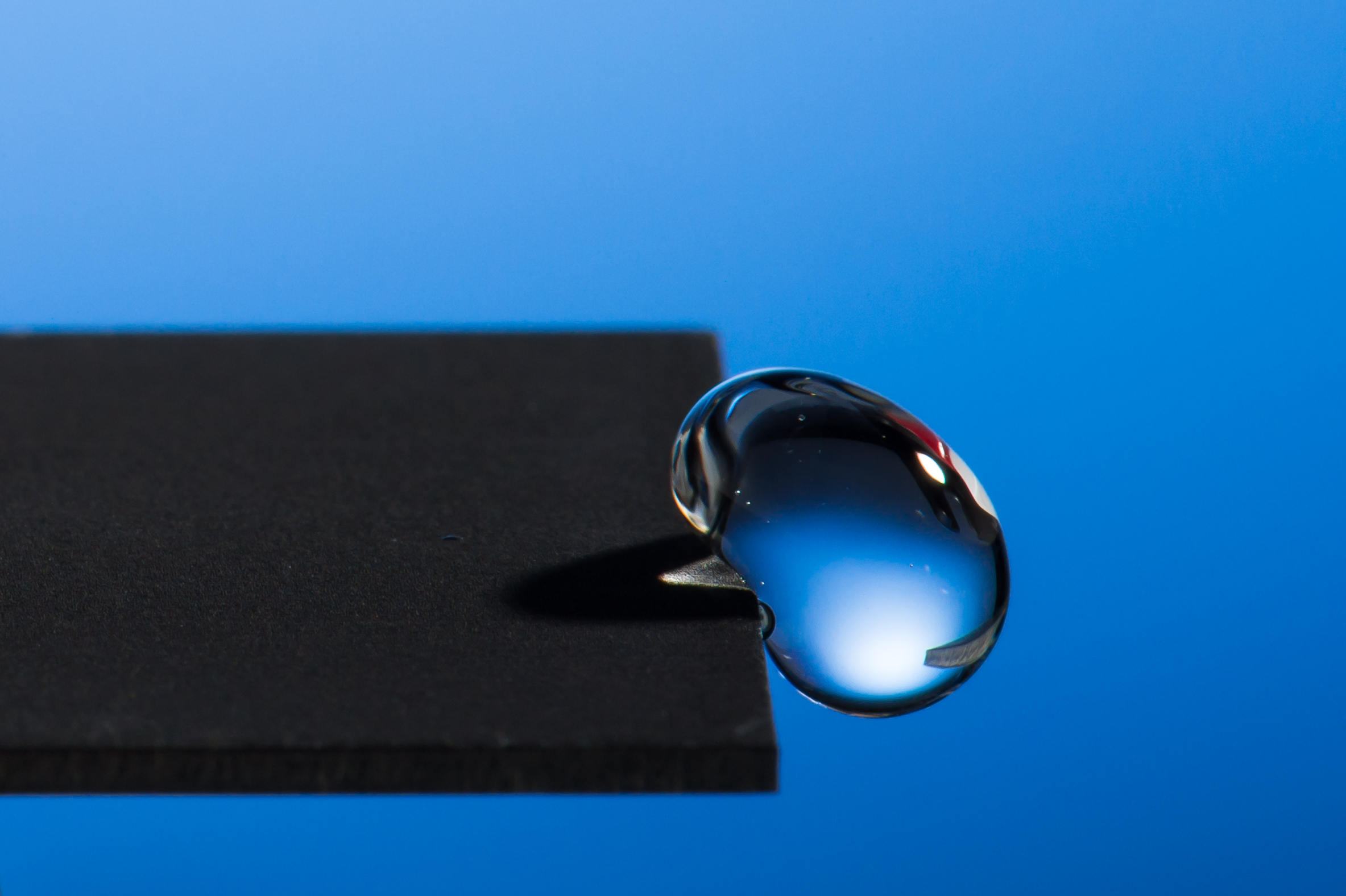
Researchers at the University of Rochester have found a more effective way to reduce water's ability to "stick" on metals. Dr. Chunlei Guo, a professor of optics and physics at the University, uses lasers to make metals more non-stick. Traditionally, Teflon is used to make a surface a 'non-stick surface', but it has its drawbacks. When Teflon is heated, it starts to decompose and detach from its metal surface; this not only has health-related implications but also performance repercussions. But with Guo's research, the use of Teflon can be eliminated. Guo and his partners shine a high-intensity laser beam onto a sheet of metal for a femtosecond. The energy it produces is about the same as the entire power grid of North America for the same amount of time and the tremendous amount of heat and energy dramatically alters the structure of the metal. Under a high-powered microscope, the altered metals have a hierarchic structure that repel water very well. In comparison to Teflon, which requires 70 degrees of tilt to allow a droplet of water to slide off, Guo's metal only requires 5. The water-repellent structure is intrinsic to the new metal surface, meaning the scientists do need ever worry about a coating sliding off. Guo and his partners hope to see their new innovation go beyond making better scrambled eggs to ensuring ice does not form on the wings of an aircraft to providing faster ships. Guo still has a long way to go before the metal can be mass produce, it takes nearly an hour of laser blasting to make a 1x1 inch piece of hydrophobic metal.
Slowing Down the Speed of Light
Researchers at the University of Glasgow and the University of Heriot-Watt have altered the speed of light...in a vacuum. Normally, the speed of light could only be altered by changing the medium in which it passes through, but these scientists believe that it's time to rewrite the textbooks. Miles Padgett, from the University of Glasgow has shown that the speed of light in a vacuum, or 2.997 x 10E8 m/s is manipulable. By altering the wave structures of some photons, and sending them on a path with the same length as that of the unaltered photon, Padgett has shown that the altered photons travel more slowly than the unaltered ones. Even if the difference in velocity was only off by 0.001 percent, the difference in amount was not accidental. He and his co-authors hope to extend this application to classical light and sound waves and hope to see this used in the field of microscope optics.
Scientists Figure Out How To Unboil Eggs
People often say that once you boil an egg, it is impossible to unboil it. Scientists at UC Irvine have proven this statement untrue. They have successfully unboiled and egg. After boiling an egg, the proteins in both the egg white and egg yolk denature; which explains why a slimy raw egg turns solid after cooking it. The once long strands of protein in the egg are broken and tangled after heat is applied to it. Burt UC Irvine's Gregory Weissaid, a biochemist, said in a statement, "In our paper, we describe a device for pulling apart tangled proteins and allowing them to refold". Adding urea to the cooked eggs liquefied it by breaking the knotted proteins into smaller bits. These "broken" proteins are then place in a 'vortex fluid device' that pieces the proteins back together within minutes- a significant improvement from older methods of reconstitution, which often took days. Unboiling eggs are cool, that is not the main focus of the researchers. Often times denatured protein remains glued on to the sides of test tubes, and scientists spend way too much time trying scrape it off. In order to mitigate this, the researchers have designed this fast new method, hoping that it will find use in industries from cheese making to pharmaceuticals.
Humboldt Squids Can Flash and Flicker
Some squids are capable of changing there skin color with a quick flash or flicker. Scientists have not been able to find a reason for this until now. Marine biologists outfitted some humboldt squid in the gulf of California with video cameras in order to see how they use their color changing skin cells. What they found was interesting. Humboldt squids tend to change their skin color when near another squid, almost like a communication method. When they are near the surface of the water, their skin turns to a sunlight color in order to camouflage themselves.
https://www.sciencenews.org/blog/science-ticker/humboldt-squid-flash-and-flicker?tgt=nr
Inflammatory Bowel Disease is Caused by Viruses
A new study done on inflammatory bowel disease shows that the true culprit behind the disease is a virus. Bacteriophages are viruses that kill bacteria. The study showed that people with inflammatory bowel disease have these viruses in their bodies. These viruses kill the good bacteria in the intestines of the patient which leads to inflammation and disease. This explains why probiotics do not help with this disease. It also explains why fecal transplants don't help either. The virus kills any new bacteria introduced into the patients body before it has a chance to do any good.
More on this Here: https://www.sciencenews.org/article/when-bacteria-killing-viruses-take-over-it%E2%80%99s-bad-news-gut?tgt=nr
Friday, January 23, 2015
The "Wind Tree"
Jérôme Michaud-Larivière, founder of a french company known as New Wind, recently finished developing a new, creative way of using wind to generate energy. Instead of big, bulky wind turbines, he made the "Wind Tree." Standing 36 feet tall, this tree has seventy-two steal "leaves" which catches the wind and twirls to create energy. These are especially good to use in the city since you cannot have huge wind turbines, and it can easily catch small wind gusts that blow around buildings. Currently they are installed in parks in Paris. With it being able to capture slow winds at two m/s, the"Wind Tree" is able to have a maximum output of 3.1k.W.
To watch a video of the "Wind Tree" click here: https://www.youtube.com/watch?x-yt-cl=84503534&list=UUCTcAWRNKWMUoJwCP9Zkgdg&x-yt-ts=1421914688&v=rDhILtKUZXs
Source: http://www.gizmag.com/wind-tree-fig-leaf-unsightly-turbines/35040/
To watch a video of the "Wind Tree" click here: https://www.youtube.com/watch?x-yt-cl=84503534&list=UUCTcAWRNKWMUoJwCP9Zkgdg&x-yt-ts=1421914688&v=rDhILtKUZXs
Source: http://www.gizmag.com/wind-tree-fig-leaf-unsightly-turbines/35040/
Tech giant Intel backs schoolboy inventor
![]() |
| Source |
13-year old Shubham Banerjee from California has received funding of "a few hundred thousand dollars" from Intel for his Braille-printing machine.What started out as a science fair project ended up becoming a full-fledged product; using pieces from Lego's Mindstorm Robotics kit, Banerjee developed a Braille printer. A keypad was attached to allow users to input text, which would then be printed out on a roll of paper, complete with the corresponding bumps. Now, he has developed a much more sophisticated version - dubbed the Braigov2.0 printer - that utilizes 3D-printed parts and Intel's very own budget-friendly Edison chip. Banerjee hopes to sell the printer for around $350, which would still be about a fifth of low-cost alternatives. And while Braille isn't heavily used among blind people, this is still a product that would greatly hope those who utilize it and perhaps even encourage more usage of Braille.
Wednesday, January 21, 2015
Drinking Moderate Amounts of Alcohol Can Reduce Risk of Heart Failure
Research and evidence has already shown that moderate drinking can prevent heart conditions, but research for the effects of drinking on heart failure has not been extensive. Although a recent study of about 15,000 men and women has shown that drinking about seven drinks a week can reduce the risk of heart failure up to 20% for men and 15% for women. This study compares these men and women to men and women who did not drink at all. This drinking also must be very controlled and moderate because abusing it can cause worse health problems like liver failure. Researchers have also studied causes of death and found that for men and women who drank more than 21 drinks a week, their risk of death went up 47% for men and 89% for women.
To Read More: http://www.sciencedaily.com/releases/2015/01/150120085927.htm
DNA of Humans Is Much Closer To Chimps Than We Thought
A new scientific discovery has shown that human traits can only be attributed to about 7.5 percent of the genome, meaning that we are almost identical to chimpanzees in DNA, but the way that our bodies process the DNA is what makes us look and think different from chimpanzees. Scientists have also found out that it is the difference in proteins and how they bond to DNA strands that creates the difference in processing with the human body and chimpanzee body.
More on this here: https://www.sciencenews.org/article/human-evolution-tied-small-fraction-genome
In theory, the Milky Way could be a 'galactic transport system'
Based on the latest evidence and theories our galaxy could be a huge wormhole and, if that were true, it could be "stable and navigable." Astrophysicists combined the equations of general relativity with an extremely detailed map of the distribution of dark matter in the Milky Way when proposing this possibility.
More on this here
Tuesday, January 20, 2015
A Brain-Computer Interface That Works Wirelessly
| Source |
Researchers at Brown University and Blackrock Microsystems, a Utah company, have commercialized a wireless device that can transmit radio thought commands to help those who are paralyzed control their electronic devices. The product is attached to the user's skull and collects these commands from a brain implant. These commands are truly brain signals which are "collected through a cable screwed into a port onto [the user's] skull, then fed along wires to a bulky rack of signal processors." It is a system that does away with a lot of the wiring of other brain data-processing machinery by compacting that technology into a device the size of an automobile gas cap, complete with a processor, circuits and radio. It it attached to the skull and hooked to electrodes inside the brain.
While it is certainly not ready for in-home use, the product is scheduled to go under FDA testing soon enough to seek clearance. If all goes well, beta testing on volunteers could commence as soon as this year. Around half a dozen paralyzed people are currently partaking in an older but similar trial known as BrainGate, and results are proving to be positive, so this technology does have a viable future. What determines is fate will be its accessibility - can all these remote-controlling with the brain work on a commercial level, one that does away with complicated headgear and excess wiring? Furthermore, can this wiring be done under the skin? That's the most dangerous yet crucial part to this project's future.
Hearing Through the Tongue
| Source |
Researchers at Colorado State University are looking to an unlikely muscle to improve the lives of the hearing impaired: the tongue.
The tongue is a highly sensitive area, which is why the researchers chose to hone in on it. They are tackling deafness much like Braille is used for blindness. With Braille, blind people, overtime, associate certain patterns of bumps to corresponding words. These researchers are substituting fingertips with the tongue and bumps with waveforms.
The system is set up in the following fashion: an earpiece containing a microphone picks up sounds and words and converts them into complex, unique waveforms to represent each different spoken word. These waveforms are then sent to a special retainer worn by the user via Bluetooth, which then uses these waveforms and electrodes to excite somatic nerves on the tongue in a manner unique to every individual word.
This is by no means an overnight process. Like with Braille, this process of hearing takes time for the user to associate patterns of touch (on the tongue) with individual words. However, what could make this an effective bit of technology is that this process is occurring in real-time. While Braille requires blind people to consciously memorize certain patterns of bumps, this retainer method for deaf people allows their brains to subconsciously link tongue patterns to individual words at the instant in which they are being spoken.
Researchers do admit, however, that this technology is optimal for the partially deaf, as they can use this to add onto the faint sounds they may hear. They also say that, if all goes according to plan, the system could cost $2,000. It may sound like a hefty sum, but it is still cheaper than the price of cochlear implants. Plus, the retainer requires no surgery. Overall, this is a very creative approach to combatting deafness.
Monday, January 19, 2015
Life Without Oil
In the United States, oil has become an essential factor because it is our main source of energy. "Oil remains the indispensable commodity, without much industrial civilization will be thrown back to the coal age." However, there are many problems with oil. For starters, it is nonrenewable, which means that eventually we will run out of oil. Along with this, oil has been a leading factor in global warming. Because of this, many scientists have been searching for more efficient and eco-friendly sources of energy that are renewable. Right now, Elon Tusk, the founder of Tesla, is making rapid improvements to a more down-to-earth technology. This technology is known as the lithium-ion battery. Tesla's "gigafactories" in Nevada and New York (possibly) will harness economies to an unprecedented degree, building on improvements that have slashed battery-based energy storage costs during the past two decades. According to Naam, the cost of electric-car batteries declined by 40 percent from 2010 to 2013. The Tesla gigafactories are designed to drive costs down at an even faster rate. To learn more about the lithium-ion battery, click on the link provided below.
http://www.bloombergview.com/articles/2015-01-16/get-ready-for-life-without-oil
Saturday, January 17, 2015
Seawater to drinkable water
Currently Carlifornia is experiencing their worst recorded drought in history. However, Californians are not the only people suffering from the lack of fresh water, nearly 700 million across the world are as well. In order to fix this problem, and to hopefully prevent it from happening again, engineers have been coming up with solutions. One in particular is to use seawater and turn it into drinkable water. Carlsbad, California is currently working on a process that upon completion will turn 100 million gallons of Pacific Ocean water into 54 million gallons of fresh water. The one problem with this is that it costs a great deal of money. As a matter in fact, seawater is the most expensive fresh water source. This is because the process requires a lot of energy. Using distillation and reverse osmosis (RO), the water's impurities and salt would be separated from the fresh water. An estimated cost to run this process is $30 million a year, most of this due to the energy it takes to pump the water through the membranes that'll clean it.
source: http://www.technologyreview.com/featuredstory/533446/desalination-out-of-desperation/
Friday, January 16, 2015
Can Siri Help NASA?
A "new Siri" has been developed by Brian Williams and his team at MIT that could eventually help NASA plan their missions in space. This new and improved artificial intelligence in not only conversational, meaning that it can smoothly interact with the user, but it is also risk-assessing. This means that the algorithms used can work by reasoning within a set of goals and constraints given by the user, while taking into account different probabilities which allows for a certain level of risk. For example, if you tell this AI that you want to catch a bus with a 90% chance of success, the AI is going to assume that you're fine with a 5% chance of taking some other form of transportation. The same type of AI can be used with NASA, but since the missions are more delicate and offer many different obstacles, the algorithm would just need to take into account more constraints and calculate more alternatives. But this would be really cool to have in cars, because it could function as the core of autopilot, which would be greatly beneficial in many ways.
More information along with video here: http://motherboard.vice.com/read/the-problem-solving-ai-of-the-future-will-be-on-your-phone
Other Planets May Be More Hospitable to Live
Scientist in the University of Toronto have discovered that exoplanets, planets outside of our solar system, may have liquid water and have better conditions than we thought that they did. Previous belief was that these planets would only have one hemisphere in the light of their star, meaning that a whole side of the planet is permanently dark and cold. This would also mean that all of the water in that side of the planet would be in frozen glaciers. Research has shown that this belief is wrong and that these planets orbit around their star having day and night cycles much like planet Earth. If these planets can sustain potential oceans than their climate might be more hospitable than we thought.
To read more: http://www.sciencedaily.com/releases/2015/01/150115163529.htm
Monday, January 12, 2015
Feces to Water
The Omniprocessor converts human waste to water and energy. The process is actually relatively simple: "sludge" is brought up to the contraption through a conveyor belt and put through a tube where all the water is evaporated via boiling and the solid matter is dumped as ash. Some of water vapor can be pressured into steam, which travels through tubes and into a steam engine to generate electricity not only for the machine itself (so that it's self-sufficient) but for the community as well. The remaining water is purified in filtration systems and completely safe to drink, even though only five minutes earlier it had been in feces!
Backed by the Gates Foundation, this machine will certainly not run into trouble with funding. It costs around $1.5 million, and according to senior program officer of the Gates Foundation's Water and Sanitation Division, Doulaye Koné, plans have already been made to meet with Senegal in February or March to iintroducethis machine to the public. If this project can take off, it would be a big step forward in the goal to provide the whole world with clean water and electricity.
Sunday, January 11, 2015
Driverless Vehicle
In this year's Consumer Electronics Show, which took place in Las Vegas, new gadgets, gizmos, and driverless vehicles were featured to more than 150,000 people from 170 countries. The event took place for four days, and it was no surprise that the driverless vehicles grabbed everyone's attention. The car that made an appearance first was the Mercedes F 015 Luxury. It had inward facing seats, set around a little coffee table, LED displays front and back to communicate with other drivers, and gesture recognition, so it can be controlled with body movements. Because most people enjoy driving, the car still featured a steering wheel.
The Mercedes was not the only model shown in the convention. Audi had a car that can arrive to pick up its driver at a touch of a button on a smart watch. Nissan also announced it was teaming up with Nasa to work on the technology too. Lastly, BMW executive Dr. Werner Huber said fully autonomous cars were still some years away, but it would be beneficial to have a robot as a co-driver in the meantime. To learn more about the convention, click on the link provided below.
http://www.theguardian.com/technology/2015/jan/09/ces-roundup-superchips-driverless-cars-drones
Friday, January 9, 2015
Computers Solved Texas Hold'em
People have been trying to design algorithms to solve different games for a long time. These algorithms already exist for games such as checkers and chess. Basically, these algorithms look at every possible move and figure out the perfect strategy to beat the opponent. However, certain games have an unpredictability factor. These are the so called "imperfect-information games," because certain information is hidden from each player. One of these games is poker. In order for computers to solve these games, they must handle the complication of not knowing certain information, which requires a lot of computer memory and power. But Neil Burch, a Ph.D. student in Computer Science, has successfully solved a two player version of Texas Hold'em by using an algorithm that he named CFR+. This is an upgrade to previous CFR algorithms that uses fewer, but bigger steps, essentially reducing the memory required and improving the program's efficiency.
More information can be found here: http://spectrum.ieee.org/tech-talk/computing/software/computers-conquer-texas-holdem-poker-for-first-time
Thursday, January 8, 2015
Coding For Kids
As we as know, coding is a useful skill, however, it is also very difficult to learn and many (women in particular) are turned off by it. The Ozobot is a robot that is made to help teach kids how to code and get them interested in it at a young age. This is also very important because as technological world expands, learning how to code will be very important for the younger generation. These small, ping pin ball-sized robots move on lines that the child draws with a special marker. These pathways can be customized by using different color markers which can tell the robot to do things such as speed up or spin. Using the software that comes with the Ozobot, children can code to direct the robot to do such certain commands. The company points out that the aim of this set is not to teach kids how to code but rather get them in the mindset of commands and interested in a skill that is useful in growing fields.
To watch the robots run click here: https://www.youtube.com/watch?v=CHOOA7dpaJw#t=24
Source: http://techcrunch.com/2015/01/05/ozobots-tiny-robots-use-squiggly-lines-and-googles-blockly-to-teach-kids-to-code/
To watch the robots run click here: https://www.youtube.com/watch?v=CHOOA7dpaJw#t=24
Source: http://techcrunch.com/2015/01/05/ozobots-tiny-robots-use-squiggly-lines-and-googles-blockly-to-teach-kids-to-code/
Sunday, January 4, 2015
ALS may have a viral cause
Russian scientists have been making claims recently that ALS may have viral cause. Because of these claims, US scientists have been investigating these options and aren't as convinced as the Russians. They did not rule out the idea, however. This theory is possible because of knowledge of a certain type of virus called a retrovirus. ALS patients have been known to have unusual retrovirus activity in their bodies, evidence to suggest that viruses may be linked to ALS. If ALS was caused by a virus, it would make it much easier to cure. This is why research into the links between ALS and virus activity is vital. More on this here:
https://www.sciencenews.org/article/cold-war-collaboration-probed-possible-viral-cause-als?tgt=nr
Monday, December 22, 2014
Germanium to Overtake Silicon?
Silicon has long been the undisputed elements behind creating transistors. Its semiconductor properties make it optimal for hosting the transfer of charges. Germanium, which is one spot below silicon on the periodic table, was experimented with in the 40s but set aside to make way for silicon because it was trickier to integrate into circuits.
Now, germanium's been making a comeback. A part of the advancement of technology has been an emphasis on miniaturization. Every gadget seems to be getting thinner and lighter, and scientists aren't sure that silicon transistors/circuits can keep up. That is why people have been turning to germanium, which, due to its position on the periodic table, can transfer charges much quicker than silicon. The limitation with using germanium had previously been making it comply with standard CMOS technology. Two types of circuits exists: nFETs, which use transistors to conduct negative charges, and pFETs, which utilize transistors to conduct positive charges. While germanium pFETs have been a "slam dunk," according Krishna Saraswat, an electrical engineer at Stanford University, the nFET version was lacking. But Purdue University engineer Peide Ye and his team have concocted a new design for germanium nFETs that could see the element be heavily used in the near future. Mark Bohr, a senior fellow at Intel, suggests that silicon scaling could be a thing of the past within a decade.
Source
Sunday, December 21, 2014
New Species Found
The first detailed research returned from the depths of the Mariana Trench. The group of scientists came back with amazing discoveries. The expedition set several new records including the gathering of the deepest rock samples and the discovery of a new fish species at the greatest lengths ever recorded as well. The findings of this expedition is going to help answer all sorts of questions people have of organisms; things like how they live in different habitats never before explored. The new species that was found is also going to give insight on how high-pressure environments influence and impact organisms.
To read more: http://www.sciencedaily.com/releases/2014/12/141220040544.htm
New species found in the deepest trenches on earth
Researchers have returned from the first detailed study of the Mariana Trench aboard Schmidt Ocean Institute's research vessel Falkor. The expedition set many new records, including the deepest rock samples ever collected and the discovery of new fish species at the greatest depths ever recorded.
Saturday, December 20, 2014
Hyperloop
Hyperloop: the new transportation system created by SpaceX
founder and Tesla Motors CEO Elon Musk that will be ready for passengers in
approximately 10 years. This new transportation system could cut travel time
between Los Angeles and San Francisco down to 35 minutes. This is incredible
because the trip typically takes 12 hours by Amtrak train, and more than six
hours by car. This transportation system would carry passengers in pods moving
as fast as 800 miles per hour. The project is approximately anywhere between $7
billion and $19 billion. Hyperloop CEO Dirk Adhlborn said that the price range
is due to the unpredictability of prices for materials and other expensive over
the next decade. He also says that if he finds it too difficult to build the
inaugural Hyperloop in California, he may choose to build it in another
country. To learn more about Hyperloop, visit the link provided below.
Friday, December 19, 2014
Solar Power From Space
Dr. Paul Jaffe, from the US Navy Research Laboratory, is working on two modules that would float in space and collect solar energy. This would increase the amount of energy collected by up to four times, especially since he wants the modules to be kilometers in length, increasing efficiency without overheating. The solar panels on Earth only catch a very small fraction of the energy being sent by the sun, and while this idea is not new, Dr, Jaffe is proposing modules that, if successfully put into effect, could power entire cities with a small collection of these modules. This is a potential new source of energy that could bring us one step closer to solving the current energy problem.
More information here: http://gajitz.com/beaming-with-pride-sending-solar-power-down-from-space/
Wednesday, December 17, 2014
3D Printed Dress
As 3D printing becomes a greater deal, people are expanding the range as to what can be printed. Nervous System, a design studio, has created a 3D printed dress that feels like a real dress. Using a software called Kinematics, the dress starts out as a model in a CAD program and then broken down into a variety of triangles. After that, hinges are attached to the triangles through the use of algorithms. This was a difficult task for the team because the hinges had to be small enough so that there could be movement between the triangles, but thick enough so that the attachment does not break. These combinations of triangles allow the dress to flow freely. Currently, producing the dress takes about two days and would sell for $3,000. Although this is the case, Nervous System is figuring out away to print them more efficiently and cost effectively.
Read more at:
Monday, December 15, 2014
BPG: A new, superior image format that really ought to kill off JPEG
For years we have been accustomed to JPEG photo files and have never questioned them. They are easily accessible by basically every computer in the world and their quality is never much of an issue. However, like the article states, JPEG is still one of those few remaining "dinosaurs" from the beginning of the internet. Is it time for a change?
Better Portable Graphics, or BPG, is the new replacement for JPEG. It offers a higher image quality at half the file size. This is due to its advanced algorithm, ability to render 14 bits per color channel (instead of 8), and like a PNG it brings an alpha channel (transparency). Overall the BPG sounds like a much better choice but its biggest flaw is its lack of support. Considering it is a new file format computers, phones, tablets, devices in general, are not programmed to support BPGs. Perhaps in the future there will be a way to easily access BPG files but for now that is something the creators are working on.
![]() |
| link to article |
Sunday, December 14, 2014
RoboBrain - Google for Robots
![]() |
| Source |
As we all remember from Robotics last year, robots need a lot of help to actually perform actions, and writing those tasks can be quite tedious. For instance, instead of being able to type, "turn right," we had to implement several lines of code involving functions for configuring the power of each motor for a certain duration of time in order to get the robot to turn. Robots don't have nearly the same interpretational skills as humans do, which is why simple tasks like movement need very descriptive instructions.
Ashushtosh Saxena and peers from Stanford University have developed RoboBrain to serve as a search engine for robots. If a robot wishes to carry out a certain task, it may search up those instructions using RoboBrain. But RoboBrain is far more than a search engine - it allows robots to add to the database as it moves along by utilizing the device's sensors and data storage in order to create information that can accessible by all kinds of robots.
The team has already demonstrated this with eggs. One of their robots, under RoboBrain, was able to carry an egg carton from one end of the table to another. This seemingly basic task can be carried even further - the technique behind carrying the egg carton can also be used for other fragile objects. All this can be learned by querying RoboBrain.
Saxena and his crew want to take RoboBrain even further. So far, the service has teamed up with Tell Me Dave (a start-tup designed to teach robots natural languages) and PlanIt (a method for robots to plan paths by using crowdsourced information). They also want to step into the instructional video world and have robots acquire knowledge simply by viewing "how-to" videos and gathering the essential parts.
4 Hour Flights are Nearing Reality
Imagine a plane that could both fly us around the earth in 8 hours and take us to space. This is the idea of the British firm called Reaction Engines with their new airplane design. This opens a whole new opportunity for commercial air flight and space travel. The new engine that will allow this is called the "Sabre Engine" and is supported by a technology that allows it to get cooled for more than 1000 degrees Celsius in 0.01 seconds. The firm is now in the development stage for this groundbreaking plane, however with the 1.1 billion dollar price tag, it may have its downsides.
Flexible 3D Touchscreens
In the not so distant future, the idea of malleable screens may become a reality. A Finnish group called Canatu has been working to develop a carbon nanobud screen which can be used in a similar fashion to glass screens. The properties of this malleable screen come from the chemical makeup of carbon nano tubing that can maintain conductivity even when displaced by 120% of its original location. The by having a surface that is easy to curve, the applications of this new technology are endless when applied to design. Some uses range from the car dashboards to computer parts.
Tons of Plastic In Oceans
To read more about this issue go here: http://www.sciencedaily.com/releases/2014/12/141210140827.htm
Saturday, December 13, 2014
The Death of the Password
The FIDO (Fast IDentifaction Organization) Alliance, which is composed of heavyweights like Microsoft, Google, VISA, MasterCard, Paypal, and more, is working with Nok Nok Labs to replace the use of passwords. Passwords are a pain. They are extremely important for the security of our data, yet they are so hard to remember and so difficult to keep track of. FIDO wants to eliminate passwords by implementing two types of user authentication factors- biometric and key. Passwords can be replaced with facial recognition, voice recognition, iris recognition, or something as simple as fingerprint recognition, as seen with the newer iPhone models. Biometric authentication is super secure because unlike a password, which can be shared by multiple people or taken through data breaches, your physical identity is unique. To add another layer of security, FIDO wants to use a physical USB key to make sure that the individual is actually attempting to log in, not a machine. This two-step verification process is what companies want for the future and although it may seem like a daunting task at first glance, the alliance believes it is definitely possible.
Mimicking Sense of Touch
Scientists have discovered how to mimic the sense of touch. A team from the US and China did this by making an experimental array that can sense pressure in the same range as the human fingertip. More specifically, they used bundles of vertical zinc oxide nano wires to build arrays consisting of about 8,000 transistors. Each of the transistors could then independently produce an electronic signal when placed under mechanical strain. This advancement is very essential because it can be applied in many different ways. For example, the advance could speed the development of smarter artificial skin. "This could make artificial skin smarter and more like the human skin. It would allow the skin to feel activity on the surface". Another way this could be applied is with robots: the sensors could give the robots a more adaptive sense of touch. As Prof Wang said, "this could be used in broad range of areas, including robotics, (very small devices known as MEMS), human-computer interferences and other areas that involve mechanical deformation". To know more about this advancement, click on the website: http://www.bbc.com/news/science-environment-22302487
Friday, December 12, 2014
Fighting Cancer
Cancer remains the second most common cause of death in the United States. More specifically, brain cancer is amongst the most tedious forms of cancer to remove during surgery since it is difficult to distinguish the difference between brain cancer and healthy brain. Because of this, surgeons many times fail to remove all of the cancer. Luckily, Dr. Jim Olson has been working on "brain paint" which will help surgeons see what is cancer. This "paint" is produced by peptides from scorpions (specifically Deathstalkers which has a paralyzing sting). The process goes: the day before surgery the patient gets an injection of "brain paint" in their blood stream. The peptide them brings the florescent molecule to the cancer cell which then is visible to the surgeons with a special camera. So far, they have experimented with this "paint" on rats and dogs, which have been successful. This can mean a lot for the future, and can increase the success rate of surgery.
Read more at:
http://www.bbc.com/future/story/20140605-how-venom-can-help-tackle-cancer
Read more at:
http://www.bbc.com/future/story/20140605-how-venom-can-help-tackle-cancer
Sunday, December 7, 2014
Spray-on Solar Power

University of Toronto researcher Illan Kramer, has invented a new way to spray solar powered cells on to flexible surfaces. Kramer has used light-sensitive materials known as colloidal quantum dots (CQD) to spray on surfaces. This new invention is going to make spray-on solar cells easy and cheap to produce. Until now, the only way that you could get CQDs on surfaces was through the process of batching them on. This process was very slow and expensive. Kramer's new process is now going to change the industry and make the process of making different materials solar powered a lot easier and cheaper.
To read more: http://www.sciencedaily.com/releases/2014/12/141205124349.htm
California's Drought Might be a Look Into the Future
Currently California is having the worst drought it has had in 1,200 years. Scientists have been able to track the droughts in California through tree rings. Tree rings can tell us vital information about the climate of a region and how dry the earth was. The fact that there was not much rain or snow this year doesn't really matter in the big picture. There have been years where the earth was less dry despite the fact that there was much less rain and snowfall than this year. The reason why this drought is bad is because of the extreme heat that is scorching the soil. Climate change is warming the soil, creating terrible droughts despite sufficient rainfall. This could be a look into the future of our Earth and how dry it will be if climate change continues.
More information on this here: http://www.livescience.com/49029-california-drought-worst-ever.html
Saturday, December 6, 2014
Hearing Wifi?
Frank Swain invested in a pair of Starkey Halo hearing aids
for his hearing that has been slowly diminishing over the course of ten years.
These hearing aids connects to bluetooth which streams audio from his iPhone. Swain began thinking, if this device can help
people hear things they could not before, it is possible to hear other things
such as wifi? So, Frank Swain and and
Daniel Jones, a sound artist, began working on a project Phantom Terrains. They hacked into his hearing aid and
translated the wifi into sounds that they could hear: crackling, clicking, and
tones. The more stronger the surrounding wifi is, the more frequent
the clicks are. So as you walk close to
a wifi router, the clicks and crackling become more dense. If it is to the left
of you, you would hear the sounds in your left ear, and the same goes for your
right. If we are able to hear wifi,
think of the number of other things we may be able to hear and how that can
potentially change our view of the world and open new findings.
If you would like to hear what it would sound like if you
were to have the hearing aid on click hear: http://www.wired.com/2014/12/guys-hacked-hearing-aids-let-listen-wi-fi-networks/
Subscribe to:
Posts (Atom)